Sunday, November 1, 2015

Scientology Building The Prison Of The Mind Part 8 Reducing Dissonance Socially

 Image result for a theory of cognitive dissonanceImage result for a theory of cognitive dissonance leon festinger

 Image result for a theory of cognitive dissonance leon festingerImage result for mental slavery

 Image result for emancipate yourself from mental slaveryImage result for social proof
 Image result for social proofImage result for ad hominem
 Image result for ad hominem

In this post like all others in the Building the Prison of the Mind series I will consult and quote Leon Festinger's book A Theory Of Cognitive Dissonance against my twenty five years in Scientology.

This post focuses on Festinger's ideas regarding reducing cognitive dissonance generated by social interactions, meaning specifically for a person from discovering others hold conflicting ideas, thoughts, opinions, emotions and behaviors.

Festinger wrote:
The larger the number of people that one knows already agree with a given opinion which he holds, the less will be the magnitude of dissonance introduced by some other person's expression of disagreement. (Page 179)

This is in psychology called social proof and in logic the bandwagon fallacy. It means we unfortunately as humans tend to feel validated by large numbers of people believing in what we believe in and behave as we do. It is ultimately irrational and fundamentally flawed. Popularity is not truth. But it is a good enough substitute that it serves to reduce dissonance. You are quite likely to feel comfortable having one person disagree with you if you know millions or billions of others agree with you. A lone voice can be easily dismissed, millions or billions are far more difficult.

As always the importance of the elements, meaning ideas, thoughts, opinions and behaviors in question determine the magnitude of dissonance. Very important elements inspire strong dissonance, moderate ones inspire moderate dissonance and unimportant elements produce little or no dissonance.

In Scientology the illusion of tens of millions of Scientologists agreeing helps to bolster agreement with Scientology, if held, but direct observations and evidence contradicts these false claims. There are tens of thousands of Scientologists, not tens of millions. And evidence leaks through despite the cult's best efforts.

So social proof is a flimsy tool in that it relies on weak lies that are contradicted by truth, particularly if one stays in Scientology for decades.

Regarding the importance as always Hubbard cleverly fools Scientologists with misdirection. He has Scientologists accept many thousands of ideas that establish an entirely new belief and behavior system but without worrying about very small and seemingly unimportant changes over time. They result in extraordinarily extreme changes, that are defended as being highly important when formed.

So becoming a Scientologist over a long time has many steps that produce small dissonance and small resistance but when these changes are  completed are firmly set and inspire tremendous dissonance and resistance to disagreement.

Other factors are the relevance of the group disagreeing. For Scientologists virtually any non Scientologists are mainly irrelevant regarding Scientology as they are seen as unenlightened and far beneath even understanding truth.
Also the degree of disagreement effects the degree of dissonance.  With Scientology's black and white thinking there is only room to agree and anything more than virtually unnoticeable disagreement is intolerable.

Festinger describes three methods for reducing dissonance in social situations. First one can reduce or possibly eliminate it by changing his or her own mind. You could change it to what others with conflicting views hold.

Hubbard safeguarded against this by having his infallible authority be the most consistent and strongest basic belief underlying all of Dianetics and Scientology. Completely turning against that is extraordinarily difficult for Scientologists. That cannot be overstated.

But obviously, as people like myself eventually do entirely reject Scientology and Hubbard it does occur, often with extreme difficulty. So after dissonance grows to tremendous, explosive levels some people respond by reconsidering and ultimately rejecting their old beliefs and behaviors.

Second, a person may gain agreement from others by persuasion. You can get them to change their minds toward agreeing with you. That seems to prove your ideas are correct. To be a bit more rational and honest that only proves you can persuade people, not that you or they are actually right. A very important difference.

And third a person can try to make another not comparable in some way. This is also incorrect from a logical or truth seeking perspective. But accepted routinely. The genetic fallacy is judging a claim based on its source. That is very poor reason as anyone can make a true or false claim. The message is not the messenger.

By deciding another or others are unqualified or inferior or evil and rejecting their claims without examination one can evade dissonance. So by  substituting emotional reactions and flawed excuses for rational thinking one can feel more comfortable, additionally by being for example disgusted by those who disagree ( Which Jon Atack explained in particular for me) one evades examining their claims while feeling justified in having negative emotions at the dame time.

In Scientology this takes the form of Hubbard's loaded language with twisting terms that include any critic of Scientology and makes all such persons equal as suppressive persons. All are entirely discredited in Scientology and loathed instinctively by Scientologists, so through the genetic fallacy and ad hominem the critics are seen as beneath deserving being heard or even tolerated, while conforming Scientologists are seen as peers worth hearing, but any dissenting voices are transferred to the other category. Additionally Hubbard placed himself as so far above everyone and everything else in his victims' minds that maintaining these relative values of ideas is of primary importance to Scientologists.

So getting Scientologists to see that a blind unwillingness to examine claims based on sources is an unwillingness to examine information that is so restrictive that it functions as a prison of the mind in itself.

 The three values of first hatefully degrading critics while failing to objectively, carefully examine claims from them and secondly listening to Scientologists only to the degree they conform exactly with authority in the form of Hubbard, or his proxy Miscavige, and rejecting them to the degree they disagree and finally to hold Hubbard and his doctrine as so far, far above criticism or doubt that going against him is unendurable together function as a very effective prison of the mind.

Somehow if you want to free a Scientologist you may need to demonstrate that the three values and really behaviors described above effectively close their mind and make objective, critical and independent thinking virtually impossible. They need to open their own minds.

Now this isn't hopeless. Most Scientologists leave and eventually reject Scientology, despite Hubbard's best efforts to permanently enslave his victims.


Friday, October 30, 2015

Scientology Building The Prison Of The Mind Part 7 Social Support And Dissonance

Image result for cognitive dissonance confusion Image result for a theory of cognitive dissonanceImage result for leon festinger

Image result for a theory of cognitive dissonance Image result for cognitive dissonance confusion


In the entire Building the Prison of the Mind series I will consult and quote the book A Theory Of Cognitive Dissonance by Leon Festinger. The entire series is an attempt to interpret Scientology and my twenty five years in the cult with the information Festinger presented in his book.

This post addresses cognitive dissonance as it relates to social support. That is interactions with groups by an individual for example among other social aspects.

On the other hand, one of the most effective ways of eliminating dissonance is to discard one set of cognitive elements in favor of another, something which can sometimes only be accomplished if one can find others who agree with the cognitions one wishes to retain and maintain. Processes of social communication and social influence are, hence, inextricably interwoven with processes of creation and reduction of dissonance. (Page 177)

This can be explained easily. A set of cognitive elements is an entire group of related ideas, behaviors and emotions that are in agreement with each other aka consonant. Dissonance is the uncomfortable feeling that accompanies conflicting ideas, behaviors and emotions. A set of cognitive elements can be an entire belief system, like Scientology. Scientology has lots of ideas, opinions, beliefs, behaviors and emotions. It is for many members nearly all encompassing.

That almost cannot be overstated. Scientology ultimately is designed to nearly completely control a cult member's decision making, even in Scientology including thoughts and emotions. And decision making is behavior. So it is intended to entirely control a person's identity, for what is left of a person if all their thoughts, feelings and actions are controlled ? Their memories and beliefs are thoughts, the meaning and values they hold are tied to emotions and everything they do is behavior, so they have nothing that is really their own left, to the degree they submit to or are influenced by Scientology.

It is worth noting that Scientology encourages a brand of isolation from dissonant elements both through outright rejection of groups and individuals that reject Scientology and quite often total immersion in the cult and intense, all consuming zealous devotion to Scientology, leaving no time for anything else. So as a Scientologist you both reject any disagreement with the cult and in behavior, and communication only embrace the cult approved elements.

Festinger goes on:
The existence of disagreement among group members of a group on some issue or some opinion, if perceived by the members, certainly produces cognitive dissonance. (Page 178)

This is something Ron Hubbard tried to tightly control. He wanted his ideas and authority to be paramount and for disagreement about him, his technology and his infallible perfection to be unacceptable and never tolerated. This has been complicated by David Miscavige taking Scientology in a different direction and significantly changing many aspects of Scientology.

After often spending decades in adherence to Hubbard's methods and doctrine, members can doubt or question Miscavige without betraying Hubbard, so tens of thousands of Scientologists have questioned Miscavige and ultimately left Scientology.

What factors affect the magnitude of the dissonance which is established by such open expression of disagreement ?(Page 178)

Plainly, what kinds of things decide how strong or weak the mental discomfort inspired by an opinion that disagrees with one's own is ?

Where the content of the opinion concerns "testable physical reality," there will be little dissonance created by social disagreement. (Page 179)

This simply means things you can check with your senses that others disagree on bother you far less than others, since you can see or feel, etc. that your opinion is true. You usually trust your own senses. USUALLY.

Very notably in Scientology Hubbard turns this against his victims, quite insidiously in fact. He redefines mental and emotional and physical phenomena as indicating very different things than they actually do to confuse, mislead and control people. He makes the symptoms of hypnotism in study technology into signs of "barriers to study" which are entirely fictional, and in auditing the very same phenomena are attributed to "gains" and other fraudulent misdirections. He does the same with language.

I covered many of these ideas in earlier blog posts such as Insidious Enslavement: Study Technology, Basic Introduction to Hypnosis in Scientology, Propaganda by Reversal of Meaning in Scientology,  the Critical factor, and the Secret of Scientology part 1 Control via Contradiction.

The point of those examples is that Hubbard used the special trick of so thoroughly redefining direct physical evidence that what would normally increase dissonance actually acts to support his unproven claims.

Additionally he makes use of hypnotic techniques which use trance logic. Regarding trance logic here is a quote from Psychweb on trance logic: "Words, in trance logic, are interpreted much more literally, communication being conveyed by focusing on words themselves rather than ideas. There is also an associated decrease in critical judgement of language being processed, and an increased tolerance for incongruity."

Trance logic is a state in hypnosis in which a person has their attention absorbed or focused so strongly that they don't exercise critical and independent thinking, they lose judgment regarding the information they take in and do not CONSCIOUSLY notice contradictions. They experience age regression and like a young child submit to authority and are willing to engage in magical thinking.

This has tremendous importance in Scientology regarding cognitive dissonance as noticing contradiction is a way cognitive dissonance is created, but by making cognitive dissonance serve to create confusion which he uses to create hypnotic trances, Hubbard inspires dissonance then "solves" it by negating the contradiction inspired dissonance by knocking out the critical factor (the capacity for critical and independent thinking, including noticing contradiction) !!

By doing this he plays an especially effective trick. He conditions his victim to habitually submit to his authority and experience relief from confusion and seeming clarity, making Scientology provide certainty - as an unthinking slave !  Remember, in a trance one can enter a pleasant worry free euphoria. Contrast this with strong cognitive dissonance which has confusion, reelingness, overwhelm, anxiety, mental blankness and physiological stress reactions.

And he also has cognitive dissonance buried in the subconscious mind of his victim, which will grow over time. The importance of this is that as buried dissonance it affects the emotions and behavior and beliefs of a Scientologist in a hidden manner. It inspires intense discomfort, anxiety and a desire to avoid or escape the feeling and associated behaviors and ideas whenever possible. So when a person encounters information that contradicts Scientology this can trigger dissonance from subconscious unhandled experiences in the mind of the Scientologist, when these experiences were ones that had a trance state from Scientology's hypnotic mind control techniques and contradictory content. Hubbard often contradicted himself and common sense and well known facts or commonly held beliefs. So his hypnotic techniques that create trance logic protect his doctrine quite routinely in Scientology indoctrination, auditing and cult activities.

What does that mean ? It means cognitive dissonance is created, but used to create hypnotic states that hide but do not eliminate dissonance. So over time entering the trance becomes automatic and the inability to perceive contradictory statements in Scientology grows but the dissonance in the subconscious ALSO grows, often to nearly maddening proportions. And when triggered by people pointing out contradictions or problems with Scientology the Scientologist often engages in ruthless passionate projection against the person that stirs up the dissonance. The reaction is often directly proportional to the hidden dissonance. For many Scientologists this is quite strong and makes reasoning with them honestly and openly with criticisms of Scientology nigh impossible.


Wednesday, October 28, 2015

What Scientologists Below The OT Levels Learn

 Image result for past lives l ron hubbard quoteImage result for past lives l ron hubbard quote

 Image result for past livesImage result for past lives


 I was indoctrinated around when OT VIII came out.The completions talked in a different way and we lowly folks who had not done the advanced levels mimicked them to pretend status.

In some of the doctrine, like SOS and the factors Hubbard uses a lie that resembles certain gnostic ideas. In it his thetans long ago were much more powerful and capable. They did not need bodies and could affect reality by will alone. The fraud goes on to say thetans have eternal infinite power and potential knowledge.

As you get more of it the entire physical universe including time is described as illusion in the minds of thetans who came to play a game.The idea he sells is that you personally were and are still a god with a capital G of your own universe.
Like the monotheist's idea of a creator who can make or destroy or influence ANYTHING within your universe.

In theory in the con you came through several universes, got confused, lost power by doubting yourself and lowered yourself to be vulnerable by your own gradual decisions over hundreds of quadrillions of years. From BEING the eighth dynamic to being less and the seventh then the sixth then the fifth then the fourth then the third and second then down to running one body for one life.

It is seen as a dwindling spiral or series of concentric circles that collapse as a being fails at one they withdraw to the next and eventually have withdrawn to nothing. In this model the thetan became human and vulnerable to human suffering from killing countless trillions as it blew up planets in space opera.

It is seen as having the next stop being permanent eternal amnesia, blindness, deafness , pain and self loathing with no end . That is the lie Hubbard sold . He claimed to restore the full God status at the end of the bridge . I am not exaggerating one bit. In several references he claimed you could restore your full abilities and entirely escape this universe and all of its liabilities forever with Scientology. Sagan may have considered that an extraordinary claim.

 The rehabilitation of the ability of the preclear to not-know is also rehabilitation of the preclear in the time stream since the process of time consists of knowing the moment and not-knowing the past and not-knowing the future simultaneously. This process, like all other Scientology processes, is repetitive. The process is run, ordinarily, only after the preclear is in very good condition and is generally run in an exterior well inhabited place. Here the auditor, without exciting public comment, indicates a person and asks the preclear “Can you not-know something about that person?” The auditor does not permit the preclear to “not-know” things which the preclear already doesn’t know. The preclear “not-knows” only those things which are visible and apparent about the person. This is also run on objects in the environment such as walls, floors, chairs and other things. The auditor should not be startled when for the preclear large chunks of the environment start to disappear. This is ordinary routine and in effect the preclear should make the entirety of the environment disappear at his own command. The environment does not disappear for the auditor. The end goal of this “not-know” process is the disappearance of the entire universe, under the preclear’s control, but only for the preclear.

- Ron Hubbard, Fundamentals of Thought

 Scientology also states that each thetan (person) "has as far as we can see in the manufacture of energy, about the same capabilities as those which have been assigned to the Supreme being in the universe" (Philadelphia Doctorate Course#9, LRH)

The race to which we are native — the theta line to which we are native — was actually highly mystic. It was capable of a lot of things — telepathy, teleportation, odds and ends, stuff — and concentrated rather heavily in that. This invader race came in with a lot of electronics and said, “Boys, all you’ve got to do is take this little jim-dandy whizzer and, you know, you will be twice as ‘thetesque’ as before.

Lecture excerpt  March 10, 1952 Ron Hubbard


Monday, October 26, 2015

Why Lying And Murder Are Justified In Scientology Part 2

Thumbnail

  • The following is a sequel to Why Lying and Murder are Justified in Scientology . It adds more information to expose how Hubbard twists words so some seemingly innocent ideas ultimately twist and turn into dehumanizing some people while praising others. The key is realizing WHO gets to decide which people are raised up and just how low the others are dropped down. 


A civilization without insanity, without criminals and without war, where the able can prosper and honest beings can have rights, and where Man is free to rise to greater heights, are the aims of Scientology
THE AIMS OF SCIENTOLOGY
Written by Ron Hubbard in September 1965

People often don't understand what Hubbard meant here. I certainly didn't while I was in Scientology.

First off, he never had any methods to actually help improve sanity or ability, and he knew it. So his only option to remove criminals and the insane was to exterminate them en masse. 


Next he talks of the able prospering and honest beings having rights. What about beings he doesn't consider honest ? He doesn't reserve ANY rights for them !

He talks of man being free to rise to greater heights - but fails to mention how such a rise could occur. Leaving man with a quite nebulous freedom indeed.

But is this all just vague philosophy with no practical applications involving anything real ? After all lots of philosophies have abstract concepts. What matters is concrete actions, particularly involving people and say governments.


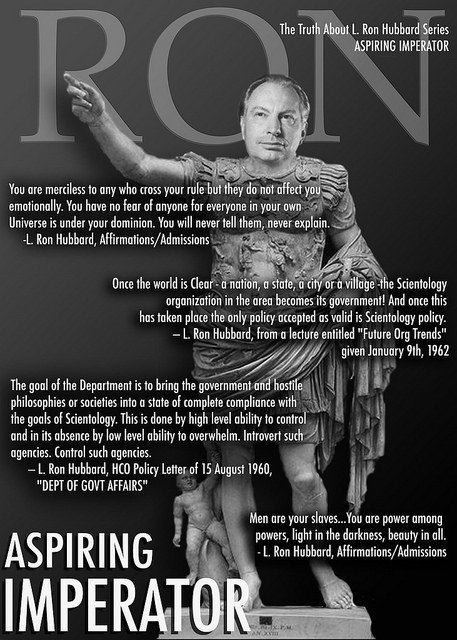
In the face of danger from Govts or courts there are only two errors one can make: (a) do nothing and (b) defend. The right things to do with any threat are to (1) Find out if we want to play the offered game or not, (2) If not, to derail the offered game with a feint or attack upon the most vulnerable point. which can be disclosed in the enemy ranks, (3) Make enough threat or clamor to cause the enemy to quail, (4) Don't try to get any money out of it, (5) Make every attack by us also sell Scientology and (6) Win. If attacked on some vulnerable point by anyone or anything or any organization, always find or manufacture enough threat against them to cause them to sue for peace. Peace is bought with an exchange of advantage, so make the advantage and then settle. Don't ever defend. Always attack. Don't ever do nothing. Unexpected attacks in the rear of the enemy's front ranks work best
HCO POLICY LETTER OF 15 AUGUST 1960 DEPT OF GOVT AFFAIRS Ron Hubbard

Here Hubbard specifically said if attacked to find or manufacture evidence and don't ever do nothing. Very specific and leaving no room for discretion or respecting legitimate authorities. 

    The goal of the Department is to bring the government and hostile philosophies or societies into a state of complete compliance with the goals of Scientology. This is done by high level ability to control and in its absence by low level ability to overwhelm. Introvert such agencies. Control such agencies. Scientology is the only game on Earth where everybody wins. There is no overt in bringing good order.
HCO POLICY LETTER OF 15 AUGUST 1960 DEPT OF GOVT AFFAIRS Ron Hubbard

Here Hubbard made it clear he wanted philosophies or societies to be in complete compliance with the goals of Scientology.  And notably he stated there is no overt in bringing good order. In the context of his other statements in the first entry in this series it is clear anything is allowed to be done to anyone Scientology decrees low tones or suppressive persons, meaning anyone unwilling to comply with Scientology's authority.  Anything including lying to or about them or murder. 

“You want to know what happens when you clear everybody in that neighborhood, the only thing that [Scientology] center can become used for is a political center. Because by the time you’ve done all this, you are the government…” —  Ron Hubbard. Taped Lecture – 9 January 1962: Future Org Trends.

Hubbard's goals, Scientology's ultimate goals, were totalitarian. He wanted his creation to take over the entire world and replace all governments.


“Once the world is Clear – a nation, a state, a city or a village – the Scientology-organization in the area becomes its government! And once this has taken place the only policy accepted as valid is Scientology policy.” — Ron Hubbard. Taped Lecture – 9 January 1962: Future Org Trends.

He here makes it perfectly clear that all laws of any kind, including any on human rights, are subordinate to Scientology policy - his policy, his ideas.

HONEST PEOPLE HAVE RIGHTS, TOO


After you have achieved a high level of ability you will be the first to insist upon your rights to live with honest people.
When you know the technology of the mind, you know that it is a mistake to use “individual rights” and “freedom” as arguments to protect those who would only destroy.
Individual rights were not originated to protect criminals, but to bring freedom to honest men. Into this area of protection then dived those who needed “freedom” and “individual liberty” to cover their own questionable activities.
Freedom is for honest people. No man who is not himself honest can be free—he is his own trap. When his own deeds cannot be disclosed then he is a prisoner; he must withhold himself from his fellows and is a slave to his own conscience. Freedom must be deserved before any freedom is possible.
To protect dishonest people is to condemn them to their own hells. By making “individual rights” a synonym for “protect the criminal” one helps bring about a slave state for all; for where “individual liberty” is abused, an impatience with it arises which at length sweeps us all away. The targets of all disciplinary laws are the few who err. Such laws unfortunately also injure and restrict those who do not err. If all were honest, there would be no disciplinary threats.
By seeking to invoke his “individual rights” to protect himself from an examination of his deeds, he reduces just that much the future of individual liberty—for he himself is not free. Yet he infects others who are honest by using their right to freedom to protect himself.
Uneasy lies the head that wears a guilty conscience. And it will lie no more easily by seeking to protect misdeeds by pleas of “freedom means that you must never look at me.” The right of a person to survive is directly related to his honesty.
Freedom for Man does not mean freedom to injure Man. Freedom of speech does not mean freedom to harm by lies.
Man cannot be free while there are those amongst him who are slaves to their own terrors.

To preserve that freedom, one must not permit men to hide their evil intentions under the protection of that freedom. To be free, a man must be honest with himself and with his fellows. If a man uses his own honesty to protest the unmasking of dishonesty, then that man is an enemy of his own freedom.
We can stand in the sun only so long as we do not let the deeds of others bring the darkness.
Freedom is for honest men. Individual liberty exists only for those who have the ability to be free.
Today, in Scientology, we know the jailer—the person himself. And we can restore the right to stand in the sun by eradicating the evil men do to themselves.
So do not say that an investigation of a person or the past is a step toward slavery. For, in Scientology, such a step is the first step toward freeing a man from the guilt of self.
Were it the intention of the Scientologist to punish the guilty, then and only then would a look into the past of another be wrong.
But we are not police. Our look is the first step toward unlocking the doors—for they are all barred from within.
Who would punish when he could salvage? Only a madman would break a wanted object when he could repair it—and we are not mad.
The individual must not die in this machine age—rights or no rights. The criminal and madman must not triumph with their newfound tools of destruction.
The least free person is the person who cannot reveal his own acts and who protests the revelation of the improper acts of others. On such people will be built a future political slavery where we all have numbers—and our guilt—unless we act.
It is fascinating that blackmail and punishment are the keynotes of all dark operations. What would happen if these two commodities no longer existed? What would happen if all men were free enough to speak? Then and only then would you have freedom.
On the day when we can fully trust each other, there will be peace on Earth.
Don’t stand in the road of that freedom. Be free, yourself.
 Ron Hubbard

The key to understanding the above policy by Hubbard is that the entire use of the terms able and honest when used by Hubbard are arbitrary. They are code words to fool the cult members. They mean people who cooperate with Hubbard, Hubbard's policies and entirely submit to his authority. And are never a danger to Hubbard or his power. They actually are reversals of truth, but hard to understand at first. Able means unable to resist Hubbard's control and certainly unable to see his true intentions. Honest starts by meaning entirely willing to tell anything to Scientology but gradually includes only believing Hubbard's claims, even when, especially when direct observations contradict Hubbard's claims.

Hubbard's brand of honesty is self deception. The right such "honest" men earn is to think, feel and behave exactly as Hubbard demanded.

Hubbard wanted all right to personal privacy revoked for anyone, anyone except of course himself. The fact that information given under the priest penitent privilege is collected for blackmail and often the privilege is revoked to help OSA or the ethics section to investigate or ruin a person. The assurances from Hubbard are simply lies for misdirection. To throw off anyone who can spot the eradication of individual rights and render their warnings powerless.

Finally, Hubbard used a particularly pernicious trick. He said on the day when we can fully trust each other there will be peace on Earth. Well, when is there peace on Earth ? Never, in our world with billions of people in over a hundred countries sadly there is always conflict. So, by his logic we can never fully trust each other.
And if we can never fully trust each other, how much can we trust each other ? But oddly we are supposed to trust Hubbard and only Hubbard.

Hubbard even had promotional materials in his organizations that said "Build trust in yourself, become a trained auditor". So, ultimately your trust in Hubbard is meant to override and overshadow your own judgment and direct observations. Scientology is a non-reality based belief system. With complete obedience, subservience and blind faith in Scientology and Hubbard providing a foundation of lies, denial and dissociation to preserve the absolute iron clad hold Hubbard's methods place upon a mind.

He ultimately wanted the individual to see his authority as justified, any objections as sure signs of hidden evil acts by evil beings unworthy of any rights and complete surrender of rights as honest and ethical. Within a framework of seeing Scientology policy as superior to and eventually replacing all laws. But the immediate acceptance of Scientology as superior to law and from a higher authority makes violating laws entirely justified, and with no laws or Scientology policy safeguarding human rights, are there truly any left at all in Scientology? No, there is an absence of rights accompanied by an illusion, an artificially created persistent delusion, of rights. Totalitarianism disguised as enlightenment. That is Hubbard's gift to the world.


"Somebody some day will say ‘this is illegal.’ By then be sure the orgs [Scientology organizations] say what is legal or not."
-  Ron Hubbard, Hubbard Communications Office Policy Letter, 4 January 1966, "LRH Relationship to Orgs"