Tuesday, May 29, 2018

Cornerstones of Critical Thinking 6 Propaganda: 7 Most Important Techniques Of Propaganda


Cornerstones of Critical Thinking 6 Propaganda: 7 Most Important Techniques of Propaganda

 Image result for propaganda 7 techniquesImage result for propaganda 7 techniques

Image result for propaganda 7 techniquesImage result for propaganda transfer device

Image result for propaganda testimonial deviceImage result for propaganda plain folks  device

 Image result for propaganda card stacking   deviceImage result for propaganda bandwagon   device

 Any good critical thinker needs at least a passing knowledge of propaganda techniques. At least learning the most prevalent ones and some history of the subject. 

Propaganda: 7 Most Important Technique of Propaganda

Psychological Warfare:

As said Propaganda as a means to influence people is not something new. It is as old as the human group and has been employed at all times and on all cultural levels. It is, however, during the First World War that it was employed as a scientifically planned means of influencing people, as a formidable psychological weapon.
Thereafter, it was constantly perfected, reaching a high point in Nazi Germany. During the Second World War, both the sides again made use of propaganda. There was a “psychological war” or “war of nerves”. Every major belligerent systematically employed political propaganda and control of news as a weapon of warfare and. psychological warfare was recognized and accepted as a military instrument.
Psychological warfare is “the use of propaganda against an enemy through the employment of modern media of mass communications, together with such other operational measures and devices of a military, economic or political nature as may be required to supplement propaganda for the purpose of reaching mass audiences in order to persuade them to accept certain beliefs and ideas.”
It is used to undermine the enemy’s resistance, to dissuade neutrals from joining the other side, or to encourage friends and others. During the Second World War it was everywhere realized that the psychological warfare was at least as important as physical combat.
The value of psychological warfare as a technique of propaganda is as yet unknown. Soreno points out that “this kind of warfare depends on the skill and ability of the warrior to understand the problems of the enemy or target people and their patterns of thought and action, and to affect them with all the means at his disposal. He also feels that psychological warfare helps political leaders to camouflage reality and to dodge responsibility.

Instruments of Propaganda:

Propaganda today has become a science as well as an art; individuals specialize in it as a profession. Though propaganda may also be utilized for educational and public welfare purposes, but this constructive kind of propaganda has hardly been so far properly utilized. It is usually carried on to serve the interests of groups rather than the general public.
Alfred M. Lee and Elizabeth B. Lee classified the propaganda devices into seven major categories:
(i) name-calling (ii) Glittering generalities, (iii) transfer, (iv) testimonial, (v) Plain-folk, (vi) Card-stacking and (vii) Bandwagon. Each of these devices makes an appeal to feelings rather than to reason. They rest upon the premise that emotion or feeling has certain strategic advantages over the appeal to reason. These propaganda devices need not be used singly; they are usually employed in combination.
To these devices Alfred M. Lee later added: Guilty-by-Association and Guilty-by-Heredity and their opposites, Virtue-by-Association and Virtue-by-Heredity. He also analysed the “techniques of basic procedure” used by the propagandist. These include: Selecting the issue: Case making; and simplification.
A brief discussion of the above seven techniques are as follows: 

(i) Name-calling:

This technique consists in giving a bad name to a person, a group, an idea or an event. The name so given arouses an emotional attitude of hostility and rejection. The terms “capitalist,” “fascist,” war-monger”, “right-reactionary” create an emotional attitude of hatred toward the person. Thus, J.P. Narayan was called by the Congress leaders a right reactionary and the B.J.P. has been called after the Ayodhya incident a fascist party and a communal organisation.

(ii) Glittering Generally:

Under this technique the propagandist uses some attractive or impressive words or ideas which mislead the people. He may call his party “the protector of Hinduism” or the “saviour of dalits” or use the words like secularism, equality, justice, democracy to influence the public.

(iii) Transfer Device:

In this device, the propagandist presents his cause as an integral part of a larger cause by identifying himself and his cause with the collective representation acceptable to the public at large. Thus, to safeguard “people’s democracy” the communists condemn all non-communists as “counter- revolutionaries.” The Congress invokes the name of Gandhi in order to bolster its position. The opposition parties use the word ‘secularism’ to defeat the Bhartiya Janta Party.

(iv) Testimonial Device:

Under this technique the propagandist advertises a thing with the name of some distinguished person. Thus the name of a film actor Ashok Kumar may be used for selling ‘Paan Parag’.

(v) Plain-folk Device:

This device is used extensively by politicians. The politician professes that he is just like others, with their common virtues and vices. Thus a leader may embrace a child in a slum area or take his lunch sitting with the slum dwellers on a mat to impress upon them that he is one of them.

(vi) Card Tactics:

This device requires skill and ingenuity. The true facts are twisted and coloured by the propagandist to suit his interest and impress his listeners. Thus, a politician may weave a story and present it as a true event.

(vii) Band-wagon:

Under this technique the propagandist advertises that since everybody is doing a thing, therefore, you may as well do it. Thus, the advertisement, “Five crores of people in India are using Alias bicycle so you also should have it today” is a band-wagon technique.
The following are a few guide-lines for a propagandist:
Firstly, repeat your idea persistently and systematically. Even falsehood, when presented incessantly, begins to appear as truth. So never be tired of repeating your side time and again.
Secondly, do not admit, do not even suggest that there is any side to the question but that one you represent. In other words, you must distort the evidence.
Thirdly, cast your cause in the role of the hero, and your opposition in the role of the villain. Resort to generalities, emolionalised symbols and stereotypes. Prove the high-mindedness, nobility and humaneness of your cause, and at the same time, demonstrate the low motives, ignoble deeds and self-seeking activities of the opposition,
Fourthly, produce testimonials on behalf of your cause, supplied by persons whose names carry a great deal of weight, such as the president of the country or a famous actor,
Fifthly, to get the most permanent eventual results your propaganda targets should be children, mix your belief in the educational curriculum. This is what totalitarian states mostly do.
But as said above, all these are methods employed by the propagandist who to serve the interests of their groups try to influence the people. In such propaganda lie as a weapon has a definite value. The Propaganda Ministry of the Third Reich used the lie successfully for several purposes. The Soviets had developed a highly skillful technique of propaganda which was their basic instrument for propagating communism abroad. The effective propaganda of the Reds was an important cause of their success.
To emphasize again, scientifically speaking propaganda is neither bad nor good. According to Katherine Gerould “propaganda is a good word gone wrong.”

The goodness or badness of propaganda depends upon what cause the particular group propounds. An American may regard a cause propounded by the Soviet as wrong.
Anyhow, the fact remains that, in modern times, even a right cause unless defended by propaganda, is virtually certain to be lost or crippled. Therefore, even a democratic state must not make itself defenseless in the field of opinion, it must meet propaganda with propaganda, pitting the correct and justified against the false and negative.

I recently completed a long series of blog posts on something many of us encourage but rarely actually discuss - critical thinking. It's essential to good reason and in my personal opinion recovery from the harm Scientology and other cults do. Here's the entire series.
Cornerstones of Critical Thinking 1 Looking at Both Sides
http://mbnest.blogspot.com/...
Cornerstones of Critical Thinking 2 Logical Fallacies and Biases
http://mbnest.blogspot.com/...
Cornerstones of Critical Thinking 3 Paul-Elder Critical Thinking Framework
http://mbnest.blogspot.com/...
Cornerstones of Critical Thinking 4 Being A Pain In The Ass
http://mbnest.blogspot.com/...
Cornerstones of Critical Thinking 5 Show The Work
http://mbnest.blogspot.com/...
Cornerstones of Critical Thinking 6 Propaganda: 7 Most Important Techniques of Propaganda
http://mbnest.blogspot.com/...
Cornerstones of Critical Thinking 7 Rhetoric and Sublime Writing
http://mbnest.blogspot.com/...
Cornerstones of Critical Thinking 8 We Learn Together
http://mbnest.blogspot.com/...

Cornerstones of Critical Thinking 4 Being a Pain in the Ass

In referencing Critical Thinking I should point out a book on the topic and strengths and weaknesses in the book and subject. How to Become a Really Good Pain in the Ass: A Critical Thinker's Guide to Asking the Right Questions by Christopher DiCarlo is an excellent book on the subject that covers a lot of the basics in the subject and the history of some people who have helped advance the subject by their actions.

One principle that is promoted as the first priority regarding critical thinking is consistency. It makes sense that you need to strive for consistency as a fundamental. You need consistent terms to even discuss critical thinking and mean today what you meant yesterday.

The history of Socrates and several other important philosophers is covered. How Socrates challenged people with questions and exposed inconsistencies in beliefs and gaps in knowledge is one of the most important developments in critical thinking.

Socratic debate and how good arguments are constructed is broken down for people as well. Any serious student of critical thinking needs to understand Socratic questions and debate and also logical fallacies and sound arguments and poor ones. These critical thinking basics are indispensable for everyone. Without them you honestly can't debate, spot poor arguments or understand what makes them poor arguments.

You will get caught up in poor logic and not be able to tell good ones from bad ones in your own thinking without this knowledge.

Several other philosophers including skeptics get recognition for their important contributions to critical thinking including separation of claims regarding nature and claims regarding the supernatural.  The approach of setting aside things you don't know about is explored as well.

I highly recommend this book, even for people who have some familiarity with critical thinking because it's so strong regarding explaining how to construct arguments and how logical fallacies impede arguments and debate. It also excels in describing the important contributions of several historical figures and the ideas they forwarded that critical thinking still is built on today.

Whether you take my suggestion and read this particular book or not all the basic components of critical thinking which it provides are ones you simply cannot do without for any serious student of critical thinking.

All in all very good for critical thinking. What's it bad at or lacking ? It has the weakness most work by an expert gets when they are dealing with something way outside their expertise.

The weak area it has is dealing with what the author calls faith. The author likely doesn't know about the work regarding influence and awe and fervor. They likely don't know about the work of people like Robert Jay Lifton regarding mass movements or Yuval Laor regarding awe and fervor or Robert Cialdini regarding influence. There's a lot more involved in faith than a knowing and conscious decision to believe something without evidence.

The lesson here is that to understand a subject you need to discover the weak points in the subject, or at least a particular author, and the strong ones and go outside the work to supplement it when needed.

This book is definitely a great start for critical thinking despite one or two weak areas. Just look outside of it regarding those areas.

I recently completed a long series of blog posts on something many of us encourage but rarely actually discuss - critical thinking. It's essential to good reason and in my personal opinion recovery from the harm Scientology and other cults do. Here's the entire series.
Cornerstones of Critical Thinking 1 Looking at Both Sides
http://mbnest.blogspot.com/...
Cornerstones of Critical Thinking 2 Logical Fallacies and Biases
http://mbnest.blogspot.com/...
Cornerstones of Critical Thinking 3 Paul-Elder Critical Thinking Framework
http://mbnest.blogspot.com/...
Cornerstones of Critical Thinking 4 Being A Pain In The Ass
http://mbnest.blogspot.com/...
Cornerstones of Critical Thinking 5 Show The Work
http://mbnest.blogspot.com/...
Cornerstones of Critical Thinking 6 Propaganda: 7 Most Important Techniques of Propaganda
http://mbnest.blogspot.com/...
Cornerstones of Critical Thinking 7 Rhetoric and Sublime Writing
http://mbnest.blogspot.com/...
Cornerstones of Critical Thinking 8 We Learn Together
http://mbnest.blogspot.com/...


Cornerstones of Critical Thinking 3 Paul-Elder Critical Thinking Framework

Doctor Richard Paul and Doctor Linda Elder are credited with creating the Paul-Elder Critical Thinking Framework. It's an example of one of several available models. It's like any creation of human beings not perfect. Perhaps a far better model will be created by someone someday. It's extremely impressive in my opinion and well worth learning.


It will take time to dig deep into it. It's related to online courses and videos and books. It's a very concise way to get a far more rational and logical approach to thinking.

After looking at it one time it's obvious a lot of thought and effort went into it. I recommend taking whatever part sticks out most to you as correct or sensible or understandable and focus on the terms, ideas and definitions used for that. 

Dig into it and see if you can think of how poor thinking lacks these things and how they are used in sound thinking.

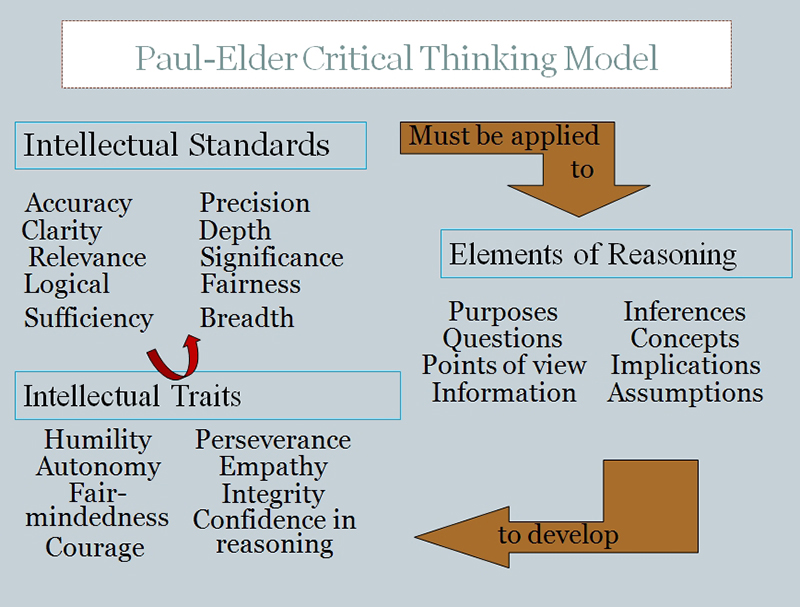
The intellectual standards, elements of thought and intellectual traits all have a place in critical thinking. 

I feel for people trying to be rational and logical, whether or not they have been in a cult or not, these ideas and this approach can be life changing.

For Scientology cult members in particular critical and independent thinking is often impaired and this framework can hopefully replace the pseudoscience and lies in Scientology with something more honest, more real and more effective.

To really understand the Paul-Elder model of critical thinking you  need to invest time. Doctors Richard Paul and Linda Elder together created numerous books and videos on critical thinking. I highly recommend reading at least one of their books on critical thinking and spending at least a few hours watching the YouTube videos and seeing one of of them instructing people how to incorporate their model into education.

Far more information is necessary to understand HOW Richard Paul implemented his system. Seeing him do it in videos is informative in a way that really nothing else is.

Below is an excerpt from the University of Louisville regarding the Paul-Elder Critical Thinking Framework. 

Paul-Elder Critical Thinking Framework

Critical thinking is that mode of thinking – about any subject, content, or problem — in which the thinker improves the quality of his or her thinking by skillfully taking charge of the structures inherent in thinking and imposing intellectual standards upon them. (Paul and Elder, 2001). The Paul-Elder framework has three components:
  1. The elements of thought (reasoning)
  2. The intellectual standards that should be applied to the elements of reasoning
  3. The intellectual traits associated with a cultivated critical thinker that result from the consistent and disciplined application of the intellectual standards to the elements of thought
Graphic Representation of Paul-Elder Critical Thinking Framework

According to Paul and Elder (1997), there are two essential dimensions of thinking that students need to master in order to learn how to upgrade their thinking. They need to be able to identify the "parts" of their thinking, and they need to be able to assess their use of these parts of thinking.

Elements of Thought (reasoning)

The "parts" or elements of thinking are as follows:
  1. All reasoning has a purpose
  2. All reasoning is an attempt to figure something out, to settle some question, to solve some problem
  3. All reasoning is based on assumptions
  4. All reasoning is done from some point of view
  5. All reasoning is based on data, information and evidence
  6. All reasoning is expressed through, and shaped by, concepts and ideas
  7. All reasoning contains inferences or interpretations by which we draw conclusions and give meaning to data
  8. All reasoning leads somewhere or has implications and consequences

Universal Intellectual Standards

The intellectual standards that are to these elements are used to determine the quality of reasoning. Good critical thinking requires having a command of these standards. According to Paul and Elder (1997 ,2006), the ultimate goal is for the standards of reasoning to become infused in all thinking so as to become the guide to better and better reasoning. The intellectual standards include:
Clarity
Could you elaborate?
Could you illustrate what you mean?
Could you give me an example?
Accuracy
How could we check on that?
How could we find out if that is true?
How could we verify or test that?
Precision
Could you be more specific?
Could you give me more details?
Could you be more exact?
Relevance
How does that relate to the problem?
How does that bear on the question?
How does that help us with the issue?
Depth
What factors make this difficult?
What are some of the complexities of this question?
What are some of the difficulties we need to deal with?
Breadth
Do we need to look at this from another perspective?
Do we need to consider another point of view?
Do we need to look at this in other ways?
Logic
Does all of this make sense together?
Does your first paragraph fit in with your last one?
Does what you say follow from the evidence?
Significance
Is this the most important problem to consider?
Is this the central idea to focus on?
Which of these facts are most important?
Fairness
Is my thinking justifiable in context?
Am I taking into account the thinking of others?
Is my purpose fair given the situation?
Am I using my concepts in keeping with educated usage, or am I distorting them to get what I want?

Intellectual Traits

Consistent application of the standards of thinking to the elements of thinking result in the development of intellectual traits of:
  • Intellectual Humility
  • Intellectual Courage
  • Intellectual Empathy
  • Intellectual Autonomy
  • Intellectual Integrity
  • Intellectual Perseverance
  • Confidence in Reason
  • Fair-mindedness

Characteristics of a Well-Cultivated Critical Thinker

Habitual utilization of the intellectual traits produce a well-cultivated critical thinker who is able to:
  • Raise vital questions and problems, formulating them clearly and precisely
  • Gather and assess relevant information, using abstract ideas to interpret it effectively
  • Come to well-reasoned conclusions and solutions, testing them against relevant criteria and standards;
  • Think open-mindedly within alternative systems of thought, recognizing and assessing, as need be, their assumptions, implications, and practical consequences; and
  • Communicate effectively with others in figuring out solutions to complex problems
Paul, R. and Elder, L. (2010). The Miniature Guide to Critical Thinking Concepts and Tools. Dillon Beach: Foundation for Critical Thinking Press.

I recently completed a long series of blog posts on something many of us encourage but rarely actually discuss - critical thinking. It's essential to good reason and in my personal opinion recovery from the harm Scientology and other cults do. Here's the entire series.
Cornerstones of Critical Thinking 1 Looking at Both Sides
http://mbnest.blogspot.com/...
Cornerstones of Critical Thinking 2 Logical Fallacies and Biases
http://mbnest.blogspot.com/...
Cornerstones of Critical Thinking 3 Paul-Elder Critical Thinking Framework
http://mbnest.blogspot.com/...
Cornerstones of Critical Thinking 4 Being A Pain In The Ass
http://mbnest.blogspot.com/...
Cornerstones of Critical Thinking 5 Show The Work
http://mbnest.blogspot.com/...
Cornerstones of Critical Thinking 6 Propaganda: 7 Most Important Techniques of Propaganda
http://mbnest.blogspot.com/...
Cornerstones of Critical Thinking 7 Rhetoric and Sublime Writing
http://mbnest.blogspot.com/...
Cornerstones of Critical Thinking 8 We Learn Together
http://mbnest.blogspot.com/...